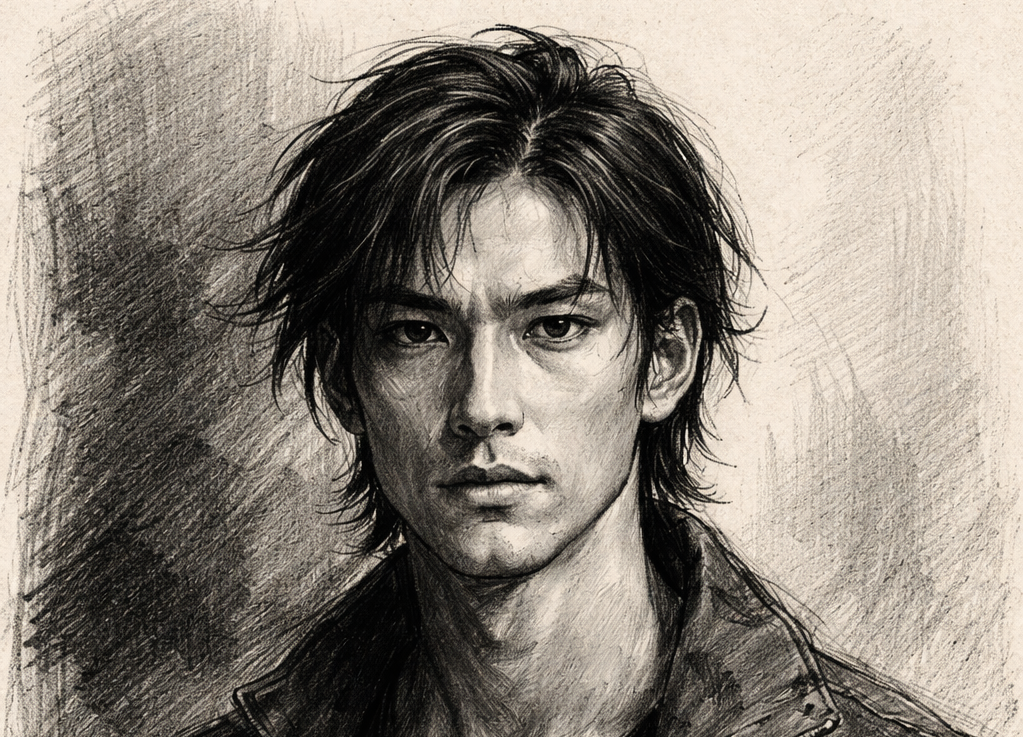
Meet Kane Kurosawa
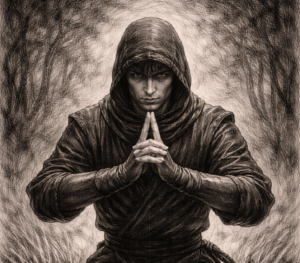
There’s a particular kind of person who moves through the world differently than most people do. Not dramatically differently — not in a way that announces itself or draws attention. It’s subtler than that. It’s in the way they read a room when they walk into it. The way they position themselves in a space without seeming to think about it. The way their attention moves — not restless, not scanning, just present in a way that most people aren’t quite present. The way they listen to what isn’t being said as much as what is.
Kane Kurosawa is that kind of person.
I’ve been living with Kane for a long time now — long enough that I sometimes have to remind myself he isn’t real, which is the best possible problem a writer can have with a character. I know how he takes his coffee. I know what he sounds like when he’s working through a problem — the specific quality of his silence, the way he goes still when he’s thinking rather than fidgeting. I know what makes him laugh, which is dry and quiet and usually arrives about three seconds after everyone else has moved on from the joke.
I thought it was time to introduce him properly.
The Early Years
Kane grew up in the foster system in East Oakland — a fact he carries without self-pity and without pretending it didn’t shape him. The system taught him things that no school curriculum covers: how to read people quickly and accurately, how to be still when stillness was the right response, how to navigate environments that had their own internal logic and rewarded the people who figured that logic out. He was observant before he was trained. The training gave form and discipline to something that was already there.
He was twelve when he walked into the dojo for the first time.
He has never been entirely clear on what drew him there — whether it was intention or accident or something that looked like one and was the other. What he is clear on is what happened after. His teacher — a man whose influence on Kane’s life is difficult to overstate, a figure who became as much mentor as instructor — saw something in the twelve-year-old standing in the entrance of the dojo and offered him a place. Kane took it.
He has been training ever since.
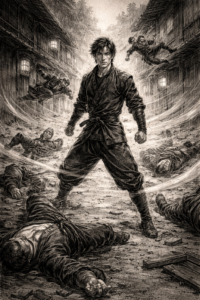
The martial art he studies is Ninjutsu — one of the oldest and most comprehensive Japanese martial traditions, comprising nine schools, each with its own history and emphasis, together forming a system that addresses not just combat but the full range of human physical and mental capability. By the time Kane is the age you meet him in The Nine Cuts, he has been training for over fifteen years. It shows in everything he does, whether or not he’s doing anything that looks remotely like martial arts.
Building a Life
Kane finished high school in Oakland and went on to San Francisco State — close enough to the city to keep training, practical enough for someone who had always been more interested in building something real than in collecting credentials. He studied business management, which suited him. He has a methodical mind and a talent for logistics — for understanding how things move, what they need, what happens when that movement goes wrong.
After graduation he tried the conventional path briefly and found it didn’t fit. He wasn’t built for the interior of an office or the rhythm of someone else’s schedule. He wanted to move. He wanted work that rewarded precision and discretion and the ability to read a situation accurately.
He started as a courier.
He was very good at it — good enough that he began to develop a reputation among a specific kind of client, the kind with specific kinds of needs. Not the standard delivery business. The other kind. Rare items. Valuable items. Things that needed to arrive exactly where they were supposed to arrive, in exactly the condition they left in, without incident and without unnecessary attention. Kane’s courier business grew into something more specialized than he had originally planned, which is how the best businesses usually develop — not from a grand design but from following what you’re actually good at until it becomes something worth having.
He is, in short, a man who moves important things carefully and gets them where they need to go. Make of that what you will when you read Book 1.
The People Who Matter
Kane is not a solitary person exactly, but he keeps a small circle and keeps it close. His friendships are old and loyal and not easily formed — the kind that come from shared history rather than shared circumstance, from having been through things together rather than simply having been in the same place at the same time.
There is Marcus — a friend from his early years whose influence on how Kane moves through the world is deeper than either of them has probably articulated. The kind of friendship that doesn’t require constant contact to remain solid, the kind where you can pick up a conversation three months after you left it and not lose the thread.
There is Claire. They dated, off and on, for a few years — the kind of relationship that worked better as a friendship and eventually found its way there, the way some relationships do when the people involved are honest enough to recognize what they actually are to each other. She remains one of the people Kane trusts most. Her name, when you encounter it in the series, will carry the full weight of that history.
And there is his teacher — the man from the dojo, the presence that runs through Kane’s life like a structural beam, not always visible but load-bearing. Their relationship is complicated in ways that the series will explore fully. What I’ll say here is that Kane’s trust in this man is complete, and that complete trust in another person is always, in fiction as in life, something worth paying close attention to.
The Thing That Makes Him Interesting
I’ve written protagonists before who were exceptional in the ways that protagonists are usually exceptional — chosen, gifted, destined, marked from birth by some quality that sets them apart from ordinary people.
Kane is not that.
What Kane has is fifteen-plus years of serious practice in a demanding tradition, a mind that processes information with unusual precision, and a commitment to action that, once made, does not waver. He is not exceptional by birthright. He is exceptional by accumulation — by the thousand decisions, made over the years, to keep showing up and keep training and keep getting better at something difficult.
He also has a quality that I find genuinely rare in fantasy protagonists, which is the ability to be wrong about something important and not collapse when he discovers it. Kane’s capacity for adjustment — for receiving information that contradicts what he believed and integrating it without denial or self-destruction — is one of the things I find most interesting about him. He’s going to need that capacity. The series is going to test it thoroughly.
He doesn’t know any of that yet.
When The Nine Cuts opens, Kane Kurosawa is a successful courier with a dojo practice, a small tight circle, and a teacher he trusts completely. He is about to be sent somewhere he didn’t ask to go, carrying things he doesn’t fully understand, toward a purpose he hasn’t been told.
He is exactly the right person for it. He just doesn’t know that yet either.
Walk well between the worlds,
Sean