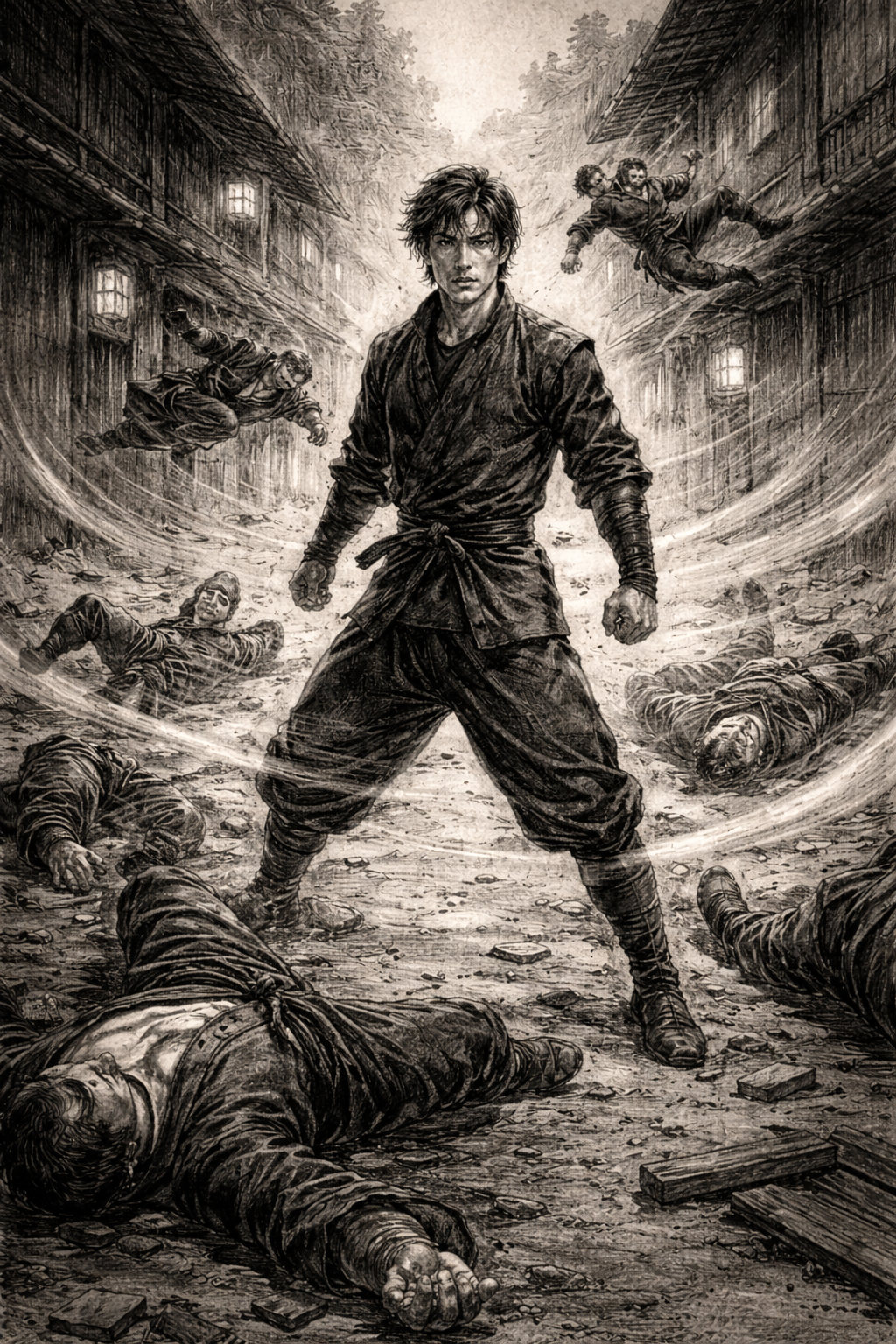
Bringing Real Martial Arts to Fantasy
The Short Version: Fantasy has no shortage of fighters. What it has very little of is martial artists. The difference matters more than you might think.
The Longer Version:
Pick up almost any fantasy novel and you’ll find someone who fights. They swing a sword, they dodge a blow, they win or lose based on the plot’s needs. The choreography might be exciting. The stakes might be real. But the fighter is rarely a martial artist in any meaningful sense — they’re a person with a weapon and narrative permission to use it.
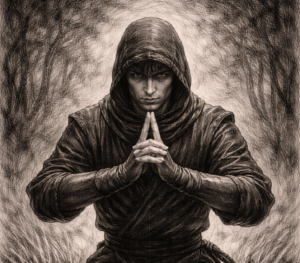
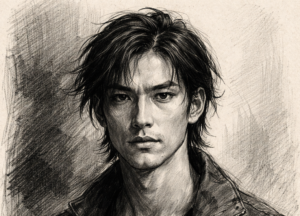
Kane Kurosawa is something different. And writing him that way required drawing on my own forty-plus years of martial arts practice.
The Void
In martial arts, there is a concept that gets called different things in different traditions. In Zen-influenced Japanese arts it’s mushin — no mind, empty mind. In the Nine Cuts series I call it the Void. It’s the state a practitioner reaches after thousands of hours of repetition, when the technique stops living in the conscious mind and moves somewhere deeper.
Most people understand this as muscle memory, and that’s not wrong. But it’s not quite right either. Muscle memory implies something mechanical — the body repeating a stored motion. The Void is something more than that. It’s the absence of the mental commentary that slows everything down. The moment you stop thinking I should block now and the block simply happens, faster than thought because it predates thought.
Kane accesses the Void throughout The Nine Cuts. It’s not a superpower. It’s not magic — at least not at first. It’s the product of a lifetime of deliberate practice arriving exactly when it needs to. Every martial artist who has trained long enough knows this feeling. It’s one of the reasons we keep training.
Economy of Movement
One of the first things a serious student learns is that big movements are slow movements. Hollywood fights are full of dramatic swings, elaborate footwork, telegraphed attacks that give the opponent a full second of warning. Real martial arts moves toward the opposite — the smallest possible motion that accomplishes the necessary result.
This shapes how Kane moves, how he thinks about space, how he reads a situation. He doesn’t perform. He doesn’t posture. When something needs to happen, it happens with the minimum necessary force in the minimum necessary time. Observers sometimes read this as stillness — as nothing happening. Then something happens, and it’s already over.
Writing this into a character requires actually understanding it. You can’t fake economy of movement on the page. The reader who has trained will know immediately if you get it wrong.
Reading Before They Act
This is a concept that surprises people most when I explain it. A trained martial artist is not waiting for an attack to arrive and then responding. By the time a strike lands, the response is already too late. What a practitioner learns — over years, sometimes decades — is to read intention before it becomes action.
A shift in weight. A change in breathing. A micro-tension in the shoulder that precedes a certain kind of movement. The eyes going somewhere specific before the body follows. These are legible if you know how to read them, and the reading happens faster than conscious thought.
Kane reads people this way constantly — not just in physical confrontations but in conversations, negotiations, rooms full of strangers. It’s the same skill applied to different contexts. The body broadcasts what the mind intends. A practitioner learns to receive that broadcast.
In Chapter 6 of Book 1, Kane encounters two men in a Niharan market who are looking for a confrontation. He doesn’t wait for it to arrive. He reads it coming and responds in a way that removes the confrontation’s premise before it can materialize. No violence. No drama. Just a shift in the situation’s logic that leaves the two men with nothing to work with.
We train for that. De-escalation is not the absence of martial arts — it’s one of its highest expressions. The ability to end a situation before it begins is more valuable than any technique.
When De-escalation Isn’t the Answer
There’s a harder truth that serious martial arts training addresses, and it doesn’t get discussed enough outside the training community.
There are situations where waiting is the wrong choice. If you are alone and someone presents a threat, you have time. You can read the situation, look for exits, attempt de-escalation, and only commit to action if all of that fails. The calculus is relatively straightforward.
If you have people with you — your children, your family, someone who cannot protect themselves — the calculus changes completely. In those situations, waiting for the threat to materialize fully may mean the threat reaches the people you’re protecting before you can stop it. The initiative and the element of surprise are assets that disappear the moment you wait for confirmation.
Serious martial arts training addresses this directly. You learn to assess not just the threat but the context. Who is with you. What they can and cannot do. What the space allows. And sometimes — not often, but sometimes — the correct answer is that you don’t wait.
This is one of the things Kane carries from his training. Not aggression. Not a hair trigger. But a clear-eyed understanding that protecting people sometimes requires acting before the situation gives you permission.
There is an alley scene in Book 1 that operates on this logic. Kane doesn’t wait for the moment to arrive. He reads it coming — and he acts.
Why This Isn’t Just a Martial Arts Book
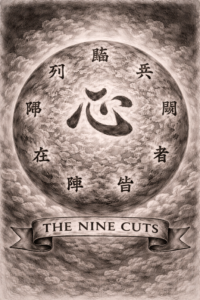
I want to be direct about something: The Nine Cuts is a fantasy series. It’s about nine worlds seeded from Earth’s actual history, magical systems rooted in real traditions, a Guardian who doesn’t know what he is yet, and a several shocks that will take nine books to fully unfold. It’s all been planned out already.
The martial arts is merely the lens through which Kane sees everything — but what he’s seeing is a world of extraordinary depth and strangeness. The Kuji-In that underlies his training becomes the foundation of an entire magical architecture spanning nine worlds. The economy of movement that he learned in a San Francisco dojo becomes the way he reads a Norse runemaster in a frozen landscape, or navigates a succession crisis in a feudal city, or understands what a demon made of corrupted worship is doing when it fights.
If you’ve never read a fantasy novel in your life but you’ve spent years on the mat — this series was written for you.
If you’ve never trained a day in your life but you love fantasy that takes its world seriously — this series was also written for you.
The martial arts is not decoration. It’s the bone structure. But bone structure isn’t the story. The story is Kane, nine worlds, and the truth that’s waiting at the end of nine cuts.
Walk well between the worlds,
Sean