Building new worlds from the bones of history
The Short Version: I’m not the most creative person in the room. I’m the one who takes what’s already in the room and rebuilds it into something new. It turns out that’s exactly the right skillset for building fictional worlds, at least to some extent.
The Longer Version:
When people find out I’m writing a fantasy series, the first assumption is usually that I spent years inventing things wholesale — languages, cosmologies, magic systems pulled from thin air. The truth is considerably more grounded than that, and honestly, I think more interesting.
I don’t so much invent as reorganize and repackage.
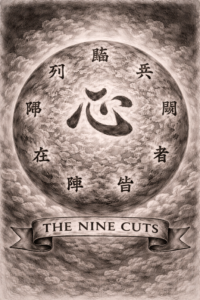
What I’m genuinely good at is taking existing information — history, folklore, cultural tradition, magical practice — and finding new configurations for it. New relationships between old pieces. New problems for old solutions, and old problems showing up in new contexts. It’s a specific kind of creative thinking, and for a long time I didn’t trust it as real creativity. I didn’t give myself credit. Writing The Nine Cuts changed that.
The premise of the series gave me exactly the playground I needed. Nine worlds, each one seeded from one or more catastrophic moments in Earth’s history, each one carrying the cultural and spiritual traditions of the people who founded it. That’s not invention — that’s relocation. Take something real, move it somewhere new, and ask: what happens next?
What happens next is where the creativity part lives.
Starting with Nihara
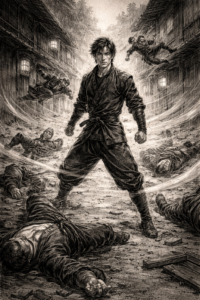
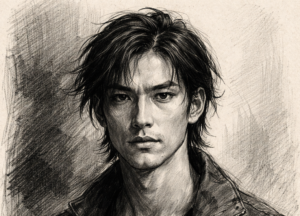
I started with a world seeded from Japanese culture for a practical reason — Kane Kurosawa is a martial artist, and Nihara gave him familiar ground to stand on at the beginning of the series. He understands the architecture of that world even if the specifics have shifted over centuries. It was the right entry point for him and for the reader.
But familiar doesn’t mean easy. The Japanese culture that seeded Nihara arrived there during the Jogan Tsunami of 869 CE — a moment of catastrophe and survival. What they carried with them were the traditions of that era: the martial arts, the spiritual practices, the folk beliefs, the understanding of the natural world that was simply how things worked before modernity explained it all away.
In Nihara, those things still work. The practices that became folklore on Earth remained living tradition there. That’s the central conceit of the entire series — belief didn’t break in the seeded worlds, and belief, it turns out, is what makes magic function.
The Architecture and the Decor
Here’s the metaphor that helped me understand what I was building:
Sometime in the deep history of the Nine Cuts universe, the caretakers of this system — whoever they were and whatever their motivations — were sourced predominantly from Asian cultures. That influence is baked into the foundation of each world. It’s the architecture of the house.
But the decor of each house belongs to the culture that moved in.
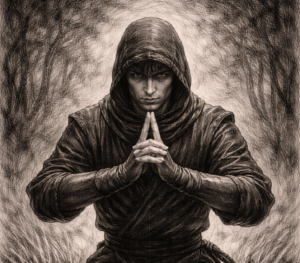
Nihara looks and feels Japanese because the people who built it were Japanese. Heimrath — the world of Book Two, seeded from Norse and Germanic Europe during the volcanic climate crisis of 536 CE — looks and feels Norse. The runic tradition there is as alive and functional as the Kuji-Kiri tradition in Nihara. Different decor, same underlying structure. The question Kane will have to answer is whether the Kuji-Kiri system is unique to Nihara, or something broader.
As the series progresses, Kane is going to walk into houses he doesn’t recognize. He’ll encounter magical systems rooted in cultures he knows only partially, or not at all. He’ll have to learn as he goes — which creates interesting problems, because the Kuji-Kiri that underlies everything is his native language, and every other system is a translation.
More on the Kuji-Kiri specifically in a future post — it deserves its own space.
What I Actually Did
The worldbuilding process for The Nine Cuts was about six weeks of focused work before I wrote a single word of the manuscript. I built the history of each world, the magical systems, the political structures, the antagonists, the relics that anchor each world’s stability. I mapped the arc across all nine books.
I used real history as my raw material. Real catastrophes as the seeding events. Real cultural traditions as the magical systems. Real folklore as the texture of each world. Then I asked: if these people had been relocated to a new world with their traditions intact and functional, what would that look like a few hundred years later? How about a thousand years later? What about three thousand years later?
The answers were genuinely surprising. And surprising myself, it turned out, was what I needed to trust that this was worth writing.
I really love worldbuilding. More than I expected to. There’s something deeply satisfying about taking the pieces of human history and culture — things that actually happened, traditions that people actually lived by — and finding new arrangements for them. New life for old knowledge.
That’s what The Nine Cuts is built on. History relocated. Belief preserved. Magic that works because the people who practice it never stopped believing it would.
Walk well between the worlds,
Sean