The Kuji-In – Nine Syllables, Nine States, Nine Doorways
The Short Version: An ancient practice rooted in Buddhist tradition, adopted by some of history’s most enigmatic warriors, and capable — in the hands of a dedicated practitioner — of producing results that are, to put it simply, extraordinary.
The Longer Version:
If you’ve spent any time around martial arts, particularly the older Japanese traditions, you’ve likely encountered the Kuji-In — even if you didn’t know what you were seeing. Nine hand gestures. Nine syllables. Nine states of mind and body that, according to tradition, a practitioner could access through focused meditation and physical practice.
What those states could produce, in the hands of someone who had truly mastered them, is a question worth sitting with, and was the impetus for one of the magical systems used in The Nine Cuts.
A Brief History
The Kuji-In — literally nine syllable cuts or nine hand seals — has roots that reach back into certain sects of Buddhism, where the hand mudras (ritual gestures) were used as meditational tools. Each gesture was associated with a specific state of consciousness, a specific quality of mind and/or body, a specific relationship between the practitioner and the world around them. The practice was inward facing — a technology for the self rather than a weapon pointed outward.
Somewhere along the way, that changed — or at least, the perception of it did.
The Kuji is known to have been practiced within Togakure-ryu, one of the oldest documented ninjutsu traditions, and likely within others whose records are less complete or less accessible. For the practitioners themselves, the Kuji remained what it had always been — a meditational discipline, a way of cultivating specific mental and physical states that made a warrior more capable, more aware, more present under pressure.
For outsiders watching those warriors operate, the picture looked somewhat different.
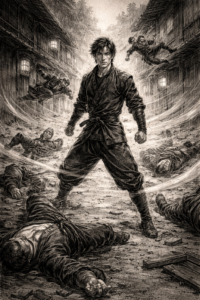
A practitioner deep in the Kai state — premonition, sense of danger — who seemed to know an attack was coming before it was launched. A warrior working within Rin — strength of mind and body — who performed under conditions that should have broken them. Someone accessing Jin — the knowing of others’ thoughts — who read a situation with an accuracy that felt like something more than observation.
From the outside, it looked like magic. It looked like supernatural ability. And so, gradually, the Kuji accumulated that reputation — a secret system of the ninja, capable of producing extraordinary results that ordinary people couldn’t explain.
Whether that reputation was earned through misinterpretation, through genuine capability, or through something in between — that’s a door the practice leaves deliberately open.
Today, the Kuji-In survives in limited form. It appears in some martial arts traditions, in certain ceremonial contexts, still in certain sects of Buddhism, and in the popular imagination — usually stripped of its meditational depth and reduced to dramatic hand gestures. The full practice, as it was understood by those who developed it, is considerably rarer.
What it was capable of, at its depth, remains an open question.
The Nine Syllables
What follows is a brief overview of each of the nine syllables — the name, the meaning, and something of what each state, fully cultivated, might look like in practice.
RIN — Strength of Mind and Body


Rin is the foundation. Before any other state can be accessed, the practitioner must be grounded in strength — not the crude strength of muscle alone, but the integrated strength of a mind and body working as a single instrument. A warrior cultivating Rin doesn’t simply become stronger in the conventional sense. They become capable of sustaining effort, absorbing impact, and continuing to function under conditions that would stop someone operating at a lesser level of integration. The results, in a practitioner who has genuinely developed this state, can appear extraordinary.
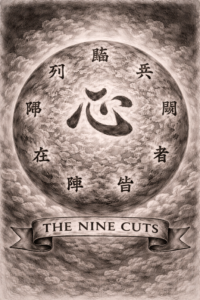
PYO — 兵 Direction of Energy


Where Rin establishes the resource, Pyo directs it. This is the state of focused intentionality — the ability to send energy, attention, and effort precisely where it needs to go without waste or scatter. A practitioner working within Pyo doesn’t flail. They don’t hesitate. Every movement, every decision, every expenditure of effort lands exactly where it was aimed. In combat, this looks like efficiency so complete it seems effortless. In other contexts, it looks like someone who simply never misses.
TOH — 闘 Harmony with the Universe


Toh is perhaps the most difficult of the nine states to describe in practical terms, because its effects are subtle rather than dramatic. This is the state of alignment — the practitioner moving in accordance with the flow of circumstances rather than against them. Things go right. Obstacles dissolve or become irrelevant. The right path becomes visible. In a warrior, this can look like extraordinary luck. In a practitioner who understands what’s actually happening, it looks like something else entirely.
SHA — 者 Healing of Self and Others


Sha addresses the body’s capacity to recover — from injury, from exhaustion, from the accumulated damage of practice and conflict. A practitioner cultivating Sha develops an accelerated relationship with their own physical restoration, and extends that capacity and skill outward to others. The mechanisms by which this operates are not fully understood, even by those who practice it seriously. What is documented, across multiple traditions, is that deep practitioners of Sha demonstrate healing rates and recovery capacities that sit outside the expected range. Whether that constitutes the extraordinary is, again, a question worth sitting with.
KAI — 皆 Premonition / Sense of Danger


Kai is the state that generated perhaps the most dramatic reputation for the Kuji system among outsiders. A practitioner deep in Kai develops what can only be described as an early warning system — a sensitivity to threat, to intention, to the shape of what’s about to happen, that operates faster than conscious analysis. In practice, this looks like someone who simply knows. They move before the attack is launched. They avoid the location before the danger arrives. They read the room in a way that feels like cheating. Whether this is highly refined sensory processing, something beyond it, or both — Kai leaves the question open.
JIN — 陣 Knowing the Thoughts of Others


Jin is the state of deep interpersonal reading — the cultivation of an awareness so attuned to other people that their intentions, emotional states, and likely actions become legible in ways that ordinary observation doesn’t account for. A practitioner working within Jin doesn’t guess at what someone is thinking. They know. Or they know enough. In negotiation, in conflict, in any situation where understanding another person’s inner state is an advantage, Jin produces results that observers consistently describe as uncanny. Or extraordinary.
RETSU — 在 Mastery of Time and Space


Retsu is the state that most strains ordinary description. Mastery of time and space — at its most practical, this refers to the practitioner’s relationship with timing and distance, the two variables that determine the outcome of almost every physical confrontation. A warrior with genuine Retsu doesn’t just have good timing. They operate in a different relationship with time than their opponent does — finding gaps that shouldn’t exist, occupying space that appeared occupied, moving through situations in ways that seem to violate the geometry of the moment. Part of this is speed — but not in the way most people understand it. A practitioner who develops genuine physical speed doesn’t just move faster. They begin to perceive differently. Because they are capable of moving faster than what they’re observing, the world around them appears to slow down — opponents telegraphing movements that arrive too late, actions unfolding in what feels like extended time. The practitioner isn’t stopping time. They’ve simply outpaced it enough that the difference becomes perceptual. At its deeper implications, Retsu points somewhere that the practice declines to fully articulate.
ZAI — 列 Controlling the Elements of Nature


Zai extends the practitioner’s awareness and influence beyond the self and into the natural environment. At its practical level, this is an acute sensitivity to weather, terrain, natural conditions — the ability to read and work with environmental factors in ways that give significant tactical advantage. A practitioner of Zai doesn’t fight the environment. They use it. At its less practical and more interesting level, Zai suggests a relationship with the natural world that goes beyond reading it — a capacity to influence it that the tradition documents carefully and discusses sparingly.
ZEN — 臨 Enlightenment


Zen is the ninth state and the destination the other eight point toward. It is not, in this context, a passive or purely philosophical condition. The enlightenment of Zen within the Kuji system is an active state — complete integration of all eight preceding states into a unified mode of being. A practitioner who has genuinely reached Zen doesn’t access strength, or direction, or harmony, or healing, or premonition separately. They access all of it simultaneously, as a single condition rather than a collection of skills. What that looks like from the outside is not something the tradition spends much time describing. Perhaps because description falls short. Perhaps because those who have seen it don’t quite have the words. Perhaps because they don’t wish others to see it.
What Comes Next
The Kuji-In is one half of a larger system. The other half — Kuji-Kiri, the nine cuts themselves — takes the meditational states of the Kuji-In and adds a physical, operative dimension that changes the nature of the practice significantly.
That’s a post for another Friday.
Walk well between the worlds,
Sean